
01Ritual Is All Around Us
The temple feels different from everyday church. There is clothing, set words, ordered movement, witnesses. The word for that is ritual, and it can feel foreign at first. The truth is, ritual surrounds you. You already do it. The temple takes the same human pattern and lifts it toward heaven.
The ritual montage
Hit play. The lesson opens with a two-minute reel of seven real ceremonies, auto-advancing through the list. Same ingredients in every one: special clothing, a symbolic act, words spoken, witnesses present.
Video Clips of Ceremonies
The same twelve ceremonies in card form, full length. Click any to open the original.
Graduation: the tassel turn
The cap and gown say "student." The tassel switching from right to left says "graduate." A symbol acts. Identity changes.
All Blacks Haka
A pre-game war chant the team performs in unison. Same movements, same words, every match. The whole stadium quiets to watch.
Presidential oath of office
Right hand raised, left hand on the Bible, the exact words written in the Constitution. The same form every four years for over 200 years.
Military oath of enlistment
Right hand to the square. A new uniform. A commitment to defend something larger than self, recited word for word.
Notre Dame, "Play Like a Champion Today"
Every Notre Dame player slaps the same sign on the way out of the tunnel. A small gesture turned into an identity-shaping ritual.
Clemson rubbing Howard's Rock
Players touch the rock before running down the hill. Called "the most exciting 25 seconds in college football."
Olympic medal ceremony
Athletes in matching dress stand on a tiered podium. Flag raised. Anthem played. Medal placed around the neck by hand.
Wedding ring exchange
White dress, set vows, ring placed on the finger, witnesses present. A symbol of commitment for life.
Knighting by the Queen
The sovereign places a sword on each shoulder. A simple gesture, hundreds of years old, that changes the recipient's title and station.
Bar Mitzvah, reading from Torah
A 13 year old boy is draped in a tallit, called to the bimah, and reads from the Torah scroll. He becomes a son of the commandment.
White coat ceremony
Medical students are presented their first white coat by a faculty mentor. A public step into the profession of healing.
Quinceañera
A 15 year old in white, a crown placed by family, the father-daughter waltz. A girl publicly steps into young womanhood.
Why this matters
If a sign slap before a football game can feel powerful, a moment with God in His own house should feel even more so. We do not invent ritual at the temple. We participate in the oldest form of it, the kind God Himself patterned in scripture.
02The Visit, Start to Finish
Plan on about three hours from when you walk in until you walk out. Eat beforehand if you are not fasting. Use the restroom. Bring an endowed family member or close friend of your same sex as your escort.
Before the day
- Recommend interviews with your bishop and stake president. You will receive a limited-use recommend for the living ordinance in addition to your regular temple recommend.
- Schedule an appointment with the temple. You cannot just walk in for your own endowment.
- Buy or rent your temple clothing. Buy your garments. The temple clothing office can help.
- Invite an escort.
- Read Moses 2:1 through Moses 5:11 in the Pearl of Great Price. The endowment narration draws heavily from these chapters.
- Read the Bible Dictionary entries President Nelson suggested: anoint, atonement, Christ, covenant, fall of Adam, sacrifices, temple.
The flow inside the temple
Open each stage below to see what happens, what it means, and what to do.
1 Arrival and recommend desk ~10 min
You step through doors that say "Holiness to the Lord, the House of the Lord." A temple worker greets you, scans your temple recommend, and welcomes you in. The hush hits you immediately. Voices are low. People move slowly.
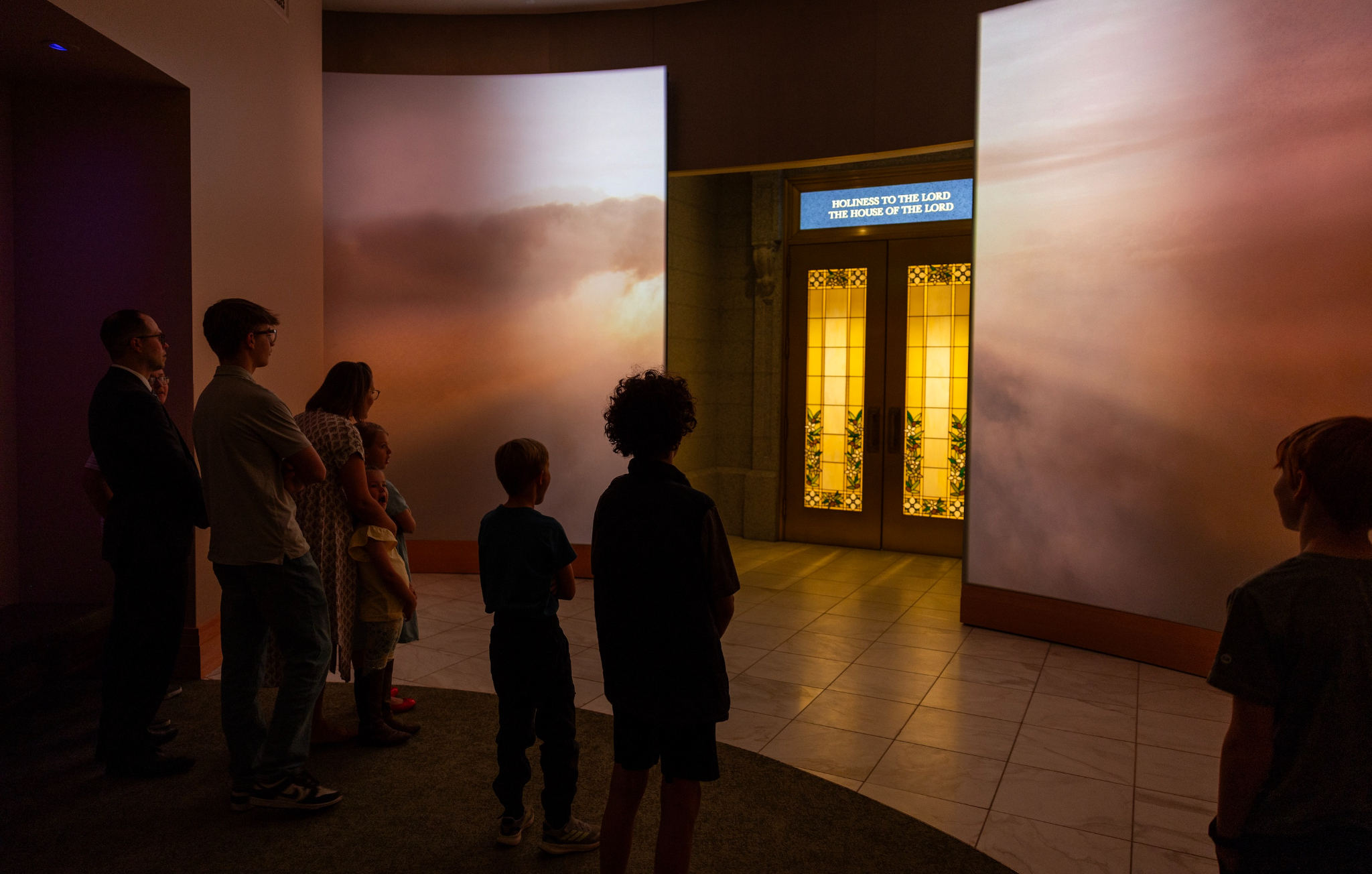
Men go to the men's dressing area. Women go to the women's. Your escort goes with you.
2 Private changing, the first time you put on the garment ~10 min
You enter a private changing stall with a locker. You change out of street clothes. You put on the temple garment for the first time. Then you dress entirely in white.
- Women: white slip, white temple dress, white stockings or socks, white slippers.
- Men: white pants, white shirt, white tie, white socks, white slippers.
You also carry a small packet of ceremonial temple clothing. Do not put it on yet. You will use it later in the endowment.
Being dressed entirely in white is intentional. Isaiah 1:18 promises that through Christ our sins, "though they be as scarlet, they shall be as white as snow." Everyone in the temple is in identical white. Differences of age, race, income, calling, all of it disappears.
3 Initiatory ordinances ~10 min
The first part of the endowment. You will be symbolically washed, anointed, taught about the temple garment, and given a new name. A worker of your same sex performs each part. The blessings use set words, the same every time, like the sacrament prayers. Beautiful. You will not remember every word. That is fine.
See Section 3 below for the full walk-through.
4 Brief conversation with a temple leader ~5 min
A member of the temple presidency may sit briefly with you and your escort, share final instructions, and ask if you have questions. This is a good moment to take a breath.
5 Endowment instruction in the ordinance room ~60 min
You enter the ordinance room, sit with your escort, men and women on opposite sides. A pre-recorded audiovisual presentation walks you through the plan of salvation: the premortal council, the creation, the fall of Adam and Eve, the atonement of Jesus Christ, and the path back to God's presence.
At marked pauses, you will put on the ceremonial temple clothing over your white clothes, and you will make five covenants, one law at a time.
See Section 4 below for the detailed walk-through.
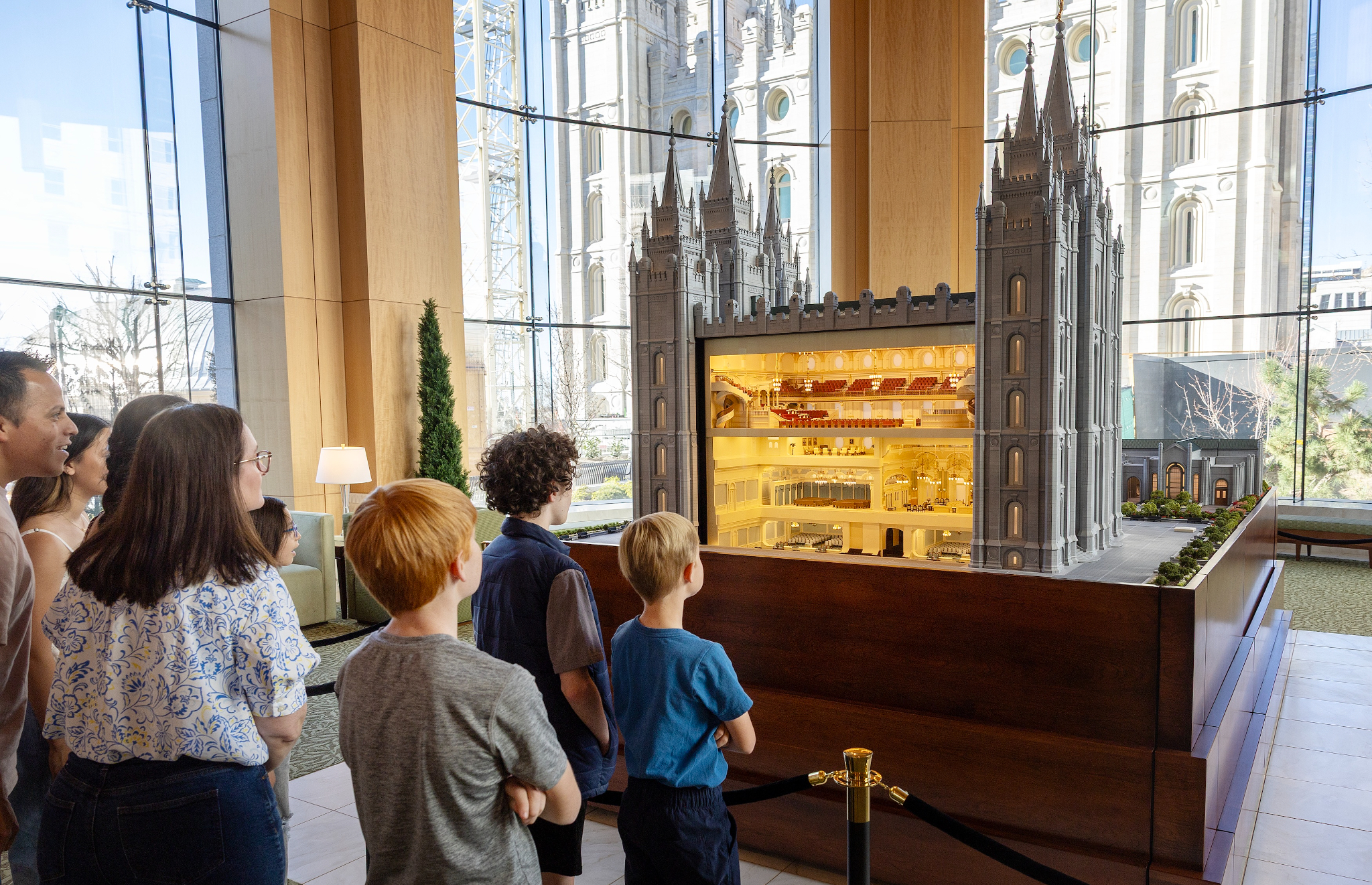
6 Prayer circle and veil ~15 min
Near the end of the endowment, a prayer is offered by those who choose to participate for the names submitted to the temple prayer roll.1
You then approach the veil. You will be asked simple set questions. A worker stands at your side and helps you give the right answers. There is nothing to fear and nothing to memorize. Each time you return to the temple, the answers are exactly the same, and a worker is always there.
You pass through the veil into the celestial room. The veil represents the body of Jesus Christ (Hebrews 10:19–20). Passing through is a symbol of coming back into the presence of God through Him.
7 The celestial room You choose
A beautiful, bright, quiet room. Crystal chandeliers, soft furniture, the feeling of being held by God. The celestial room represents life with our Heavenly Parents.
You can pray, ponder, write in a journal, or talk softly with family. Stay as long as you want. Many people receive personal revelation here that shapes the rest of their week.
8 Change and leave ~10 min
You return to the changing room, take off the temple clothing, change back into street clothes, and leave the temple. You walk back out into the world. Different. You have been endowed.
You are not the only one
Unlike baptism, you are not the only person in the room receiving an ordinance. Others around you are receiving their own endowment or acting as proxy for someone who has died. Everything they do, you will do. That takes the spotlight off you and lets you focus on the Lord.
03The Initiatory, In Detail
The first part of the endowment ceremonies. About five to ten minutes. The word initiatory means "a beginning" and signals your initiation toward one day becoming a priest or priestess to God.
A The washing
You are symbolically washed with a drop of water on your head. A temple worker pronounces a set blessing using the same words every time.
This is the same pattern the Lord gave Moses when he consecrated Aaron and his sons to be priests in the tabernacle. Exodus 40:12 says, "Thou shalt bring Aaron and his sons unto the door of the tabernacle of the congregation, and wash them with water."
B The anointing
A small drop of consecrated olive oil is placed on your head. A temple worker pronounces a set blessing.
Same ancient pattern. Exodus 40:13: "Thou shalt put upon Aaron the holy garments, and anoint him, and sanctify him; that he may minister unto me in the priest's office." Throughout the Old Testament, kings and priests were anointed to consecrate them for sacred service. The title Christ (Greek) and Messiah (Hebrew) both mean "the anointed one."
C The garment
You are formally authorized to wear the temple garment, which you put on in the changing stall a few minutes earlier. Its proper name is the garment of the holy priesthood. The garment is sacred, worn under outer clothing for the rest of your life, and is a constant reminder of the covenants you make in the temple.
"Wearing the temple garment has deep symbolic significance. It represents a continuing commitment. Just as the Savior exemplified the need to endure to the end, we wear the garment faithfully as part of the enduring armor of God. Thus we demonstrate our faith in Him and in His eternal covenants with us." President Russell M. Nelson, "Personal Preparation for Temple Blessings," April 2001 General Conference.
The garment also recalls the "coats of skins" God made for Adam and Eve after the Fall (Genesis 3:21). They had tried to cover themselves with fig leaves. God replaced that with something better. An animal died so they could be clothed. That animal pointed to Christ, and the covering pointed to His Atonement covering our sins.
From the General Handbook: the garment is worn beneath outer clothing, should not be removed for activities that can be reasonably done while wearing it, and should not be modified to fit different styles of clothing.
D The new name
You receive a new name. It is symbolic. It is not a name from a past life and not a foreign language. Scripture is full of moments when deep covenant changes a person's name.
- Abram becomes Abraham (Genesis 17).
- Jacob becomes Israel (Genesis 32).
- Saul becomes Paul (Acts 13).
- The Lamanites who repented took the name Anti-Nephi-Lehies (Alma 23:17).
Your new name marks the day you made covenants in the House of the Lord. Remember it throughout your life. If you ever forget it, a member of the temple presidency can remind you.
President Brigham Young said the new name is among the "key words" you receive in the endowment, words that point to the Savior and your covenants with Him.
One pattern, then and now
Wash, anoint, clothe, name. That is the consecration sequence the Lord gave Moses for Aaron in the tabernacle. That is what happens to you in the initiatory. The temple did not invent this. It restored it.
04The Endowment Session
The English word endowment means a gift. This is the heart of the temple. Below is what the gift is, what happens in the ordinance room, and the covenants you make.
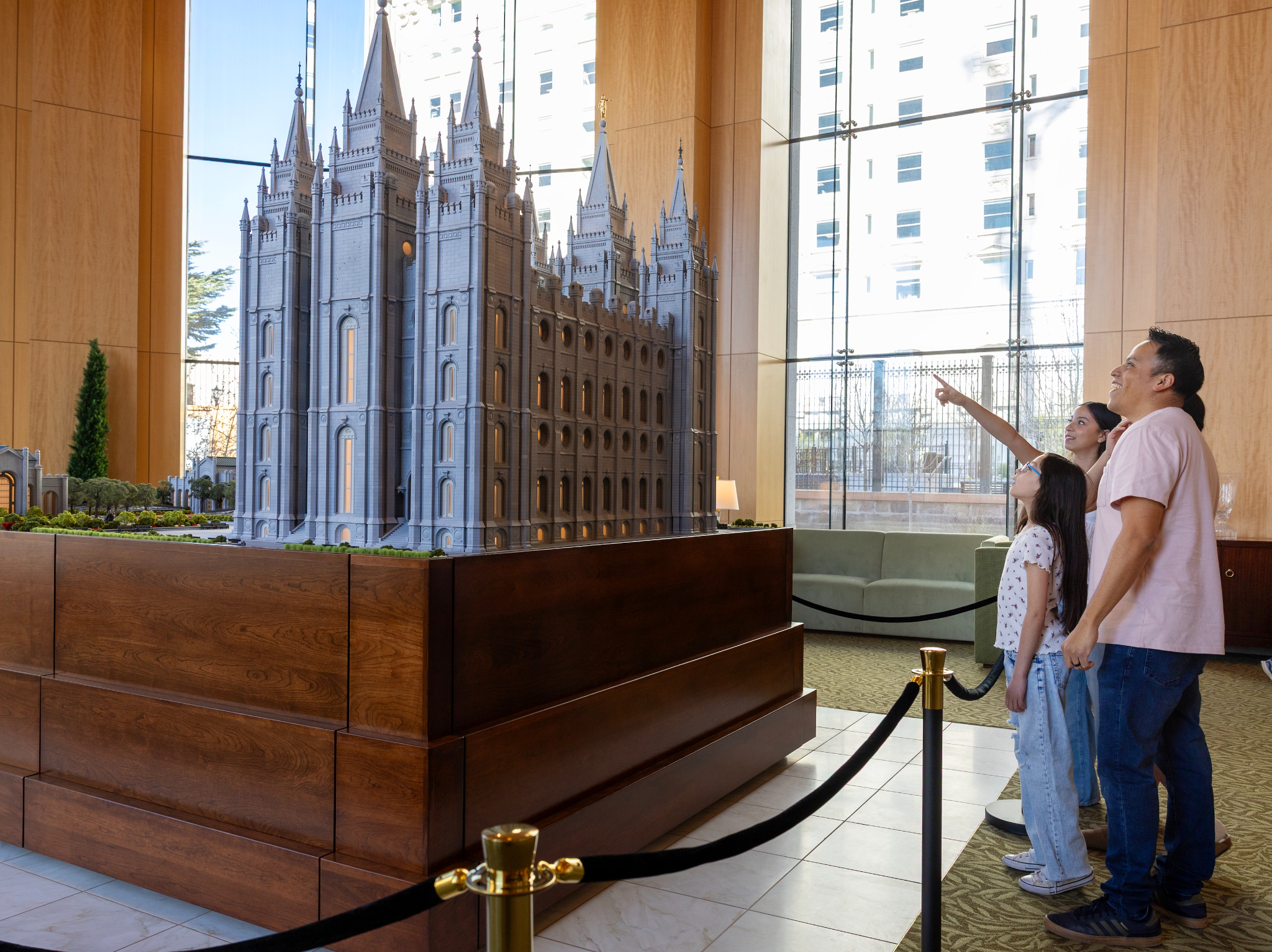
The endowment is a gift
The Lord uses the word endow directly when speaking of the temple. D&C 95:8 calls it a place built "to endow those whom I have chosen with power from on high."
"Your endowment is, to receive all those ordinances in the house of the Lord, which are necessary for you, after you have departed this life, to enable you to walk back to the presence of the Father, passing the angels who stand as sentinels, being enabled to give them the key words, the signs and tokens, pertaining to the holy Priesthood." President Brigham Young, in Teachings of Presidents of the Church: Brigham Young, ch. 32.
The endowment teaches three things at once:
- Who God is and what His plan looks like.
- Who you are, a child of God invited to become a king or queen, a priest or priestess in His kingdom.
- How you walk back to Him, by covenant, through Jesus Christ.
Inside the ordinance room
About an hour. The pre-recorded presentation has three big movements: creation, fall, redemption. Throughout, you put on ceremonial clothing, make five covenants, and learn key words, signs, and tokens that point to Jesus Christ.
The ordinance room and the altar
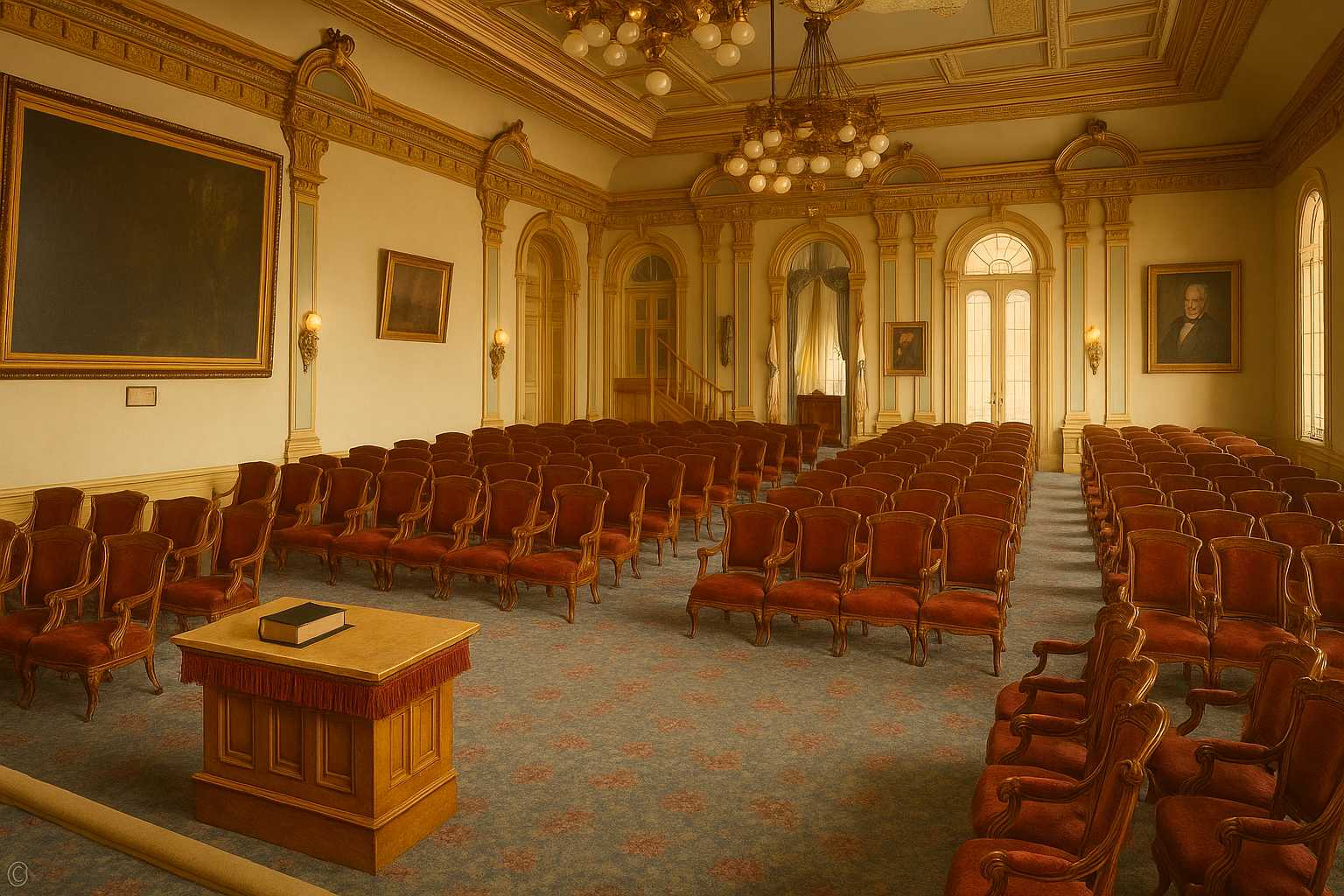
You enter the ordinance room and sit with your escort. Men and women sit on opposite sides. Toward the front is an altar. Altars in scripture have pointed to the Atonement for thousands of years. Abraham bound Isaac on an altar, "a similitude of God and his Only Begotten Son" (Jacob 4:5). Moses commanded Aaron to "go unto the altar, and offer thy sin offering" to make atonement for the people (Leviticus 9:7). We no longer offer animal sacrifice, but the altar still points to the one perfect Sacrifice.
The three movements of the presentation
I The Creation
The presentation opens with the premortal council in heaven, then the creation of the world: light, sky, land, plants, animals, and finally Adam and Eve, placed in the Garden of Eden.
This is drawn from Moses 2 and Genesis 1. Heavenly Father and Jesus Christ are central characters throughout. You are watching the work of creation done by God for His children.
II The Fall
Satan tempts Adam and Eve. They partake of the forbidden fruit. They try to cover themselves with fig-leaf aprons, a symbol of trying to hide their sin from God by their own effort. The Lord then makes "coats of skins" for them (Genesis 3:21). Something had to die so that they could be properly covered. That something pointed to the Lamb of God.
The Lord sends them out of the Garden of Eden. Now they must live in mortality, learn good from evil, and find the path back to His presence. Their story is your story.
III The Redemption
Adam and Eve strive to return to the presence of God. Jesus Christ plays the central role in their redemption, just as He does for us. Throughout this final movement, the presentation prepares you not just to return to God's presence but to return as an heir of His glory. The scriptural and prophetic language is precise: kings and priests, queens and priestesses to God.
"Metaphorically speaking, we are on the journey with Adam and Eve." John Hilton III, Your First Temple Visit: A Practical Guide.
The ceremonial clothing
At marked pauses, everyone puts on the ceremonial temple clothing over their white clothes. Robe, sash, apron, and a head covering (cap for men, veil for women). The clothing is patterned after the clothing of ancient priests (Exodus 28). Putting it on is symbolic of being clothed with God's power and glory, of preparing to enter into His presence.
The Church has published a brief, reverent video called Sacred Temple Clothing that shows the robes with proper context.
The five covenants and the covenant path
Five times during the presentation, the narration pauses and you covenant with God to live a specific law. Each covenant is described publicly in the General Handbook (section 27.2).
The covenant path
You have already been walking it. At baptism (Mosiah 18:8–10; D&C 20:37) you covenanted to take Christ's name, keep His commandments, mourn with those that mourn, stand as witnesses, and serve. Every Sunday at the sacrament you renew that covenant. The temple covenants below are not a different path. They are the same direction, taken further. President Nelson calls this the covenant path: baptism, sacrament, and temple ordinances bound together as one walk back to God.
The Law of Obedience
You covenant to obey God's commandments and strive to keep His will above your own. This is the foundation of every covenant that follows.
The Law of Sacrifice
You covenant to sacrifice in support of the Lord's work and to come before Him with "a broken heart and a contrite spirit" (3 Nephi 9:20). After the Atonement, the sacrifice God asks of you is your heart and your will.
The Law of the Gospel of Jesus Christ
You covenant to live the higher law Jesus taught during His mortal ministry: exercising faith in Him, repenting daily, making and keeping covenants, enduring to the end, loving God and loving your neighbor (Matthew 22:37–40).
The Law of Chastity
You covenant to have no sexual relations except with the person you are legally and lawfully married to according to God's law, a husband and a wife. This protects the power to create life and keeps you worthy of the Spirit.
The Law of Consecration
You covenant to dedicate your time, talents, and everything the Lord has blessed you with to building up the Church of Jesus Christ on the earth. This is the highest law. By the time you reach it in the ceremony, you know the endowment is nearly complete.
"Each temple ordinance is not just a ritual to go through. It is an act of solemn promising." President Russell M. Nelson, "Personal Preparation for Temple Blessings," April 2001 General Conference.
Key words, signs, and tokens
Brigham Young taught that you will receive "key words, signs, and tokens, pertaining to the holy Priesthood." The new name from the initiatory is one of the key words. Others come during the endowment.
The word sign in Joseph Smith's day meant simply "a gesture," and token meant "something intended to represent another thing" (Webster's 1828). Lifting hands in prayer is a sign. The square-arm gesture used in baptism is a sign. The temple uses gestures with symbolic meaning that point to Christ.
The prayer circle
Near the end of the presentation, a prayer is offered by those who choose to participate for the names submitted to the temple prayer roll.1
Passing through the veil
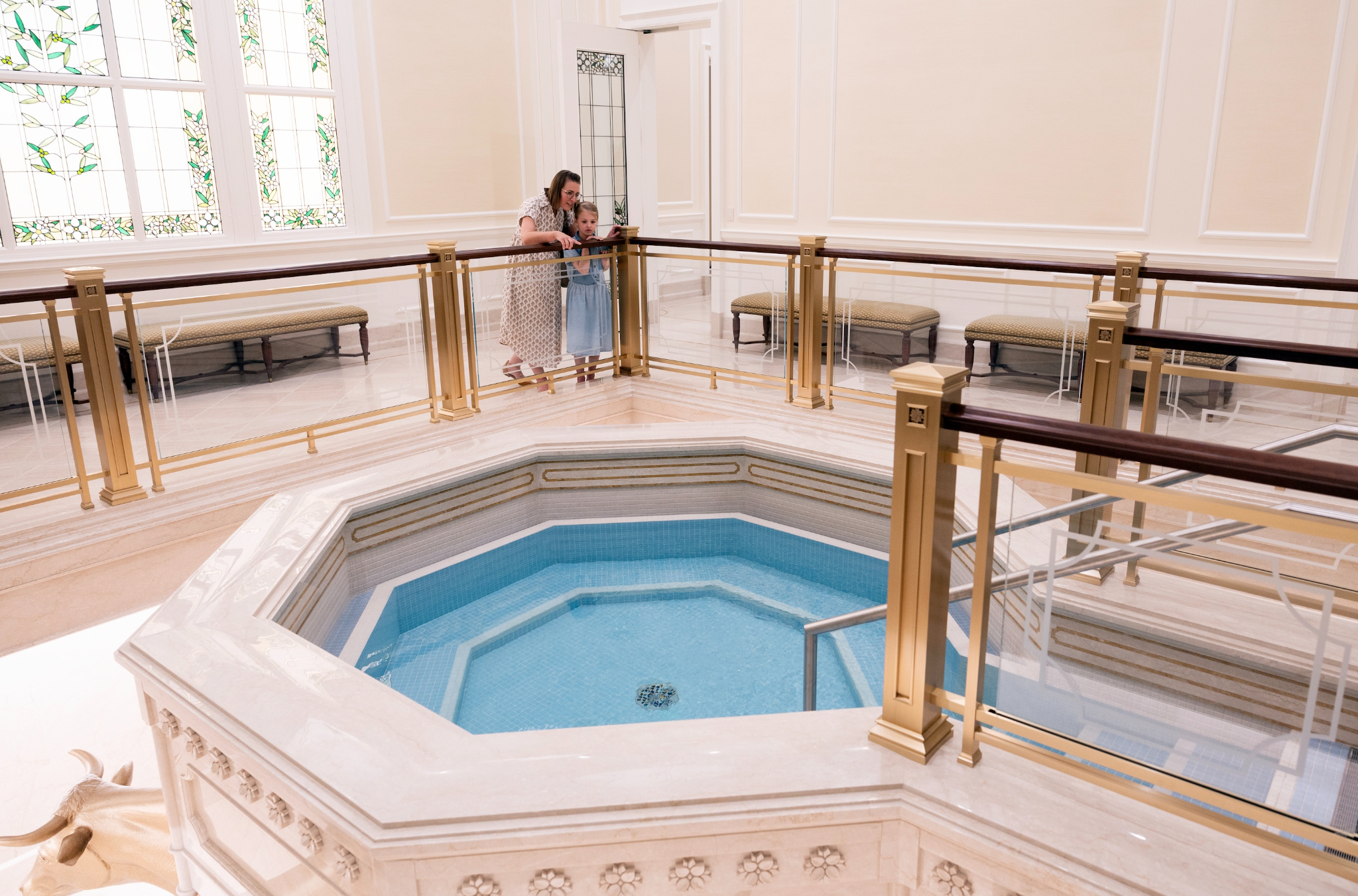
You approach the veil. You are asked simple questions about what you have learned. A temple worker stands with you and helps you give the answers. There is nothing to memorize, and a worker is always there, every time you return.
You pass through the veil into the celestial room. The veil is one of the most layered symbols in the temple. When the Savior died, "the veil of the temple was rent in twain from the top to the bottom" (Matthew 27:51). The book of Hebrews tells us what that meant:
"Having therefore, brethren, boldness to enter into the holiest by the blood of Jesus, by a new and living way, which he hath consecrated for us, through the veil, that is to say, his flesh." Hebrews 10:19–20.
The veil represents Jesus Christ. Through Him, the way back to the presence of God is open.
The celestial room
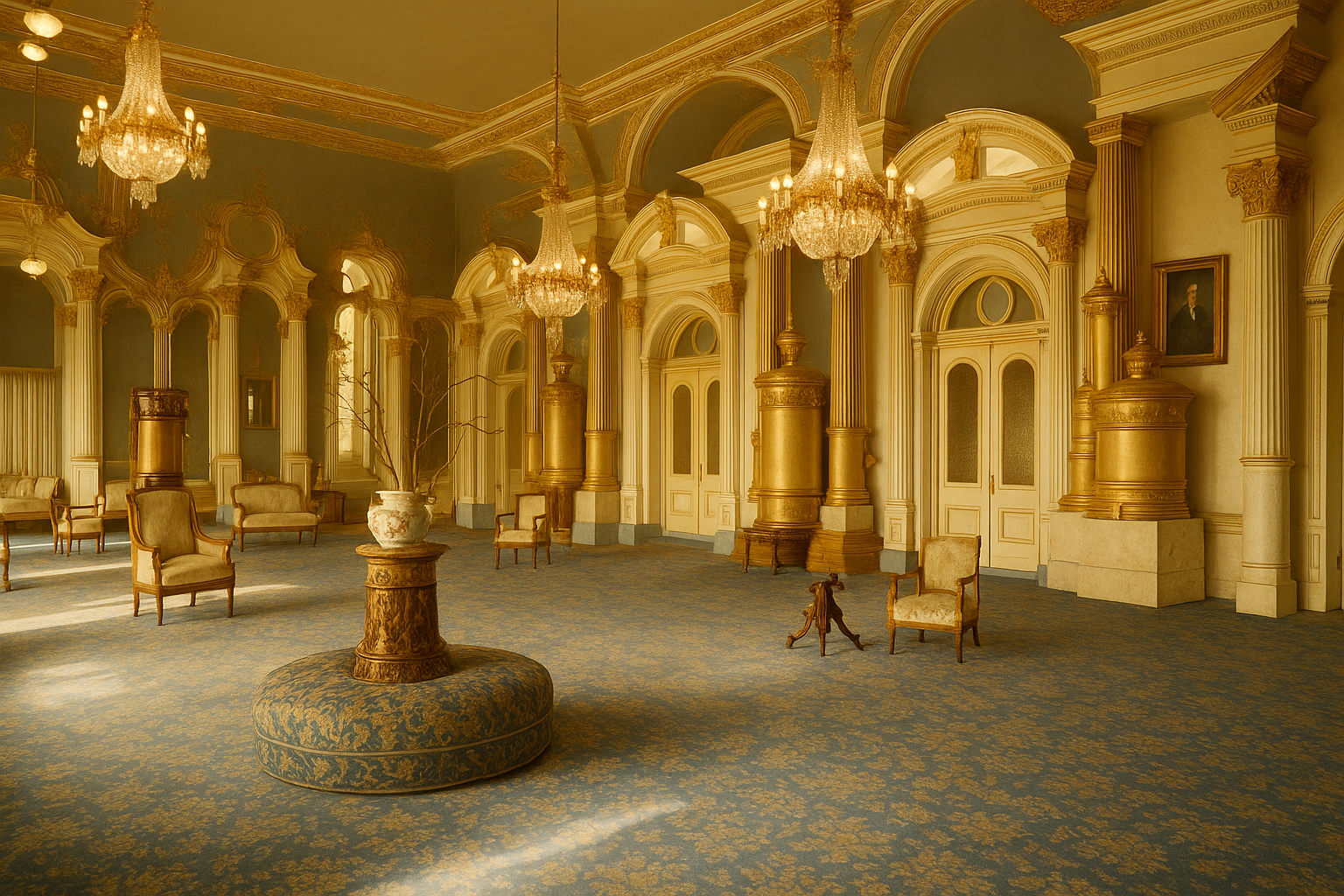
You step into a bright, ornate, quiet room. Crystal chandeliers, soft furniture, light pouring in. This room represents the celestial kingdom, life with our Heavenly Parents. You can pray, ponder, write, or sit quietly with family. Many of the most meaningful moments of a person's life happen here. Stay as long as you like.
05Symbols, A Quick Reference
"Everything in the temple has a symbolic meaning." Do not try to decode every symbol on day one. The temple is meant to be visited again and again. The symbols open over a lifetime.
White clothing
Everyone wears identical white. Differences disappear. Reminds us that through Jesus Christ our sins, "though they be as scarlet, they shall be as white as snow" (Isaiah 1:18).
Ceremonial robe, apron, sash, head covering
Patterned after the clothing of ancient priests (Exodus 28). Putting it on is symbolic of being clothed with God's power and glory.
The garment of the holy priesthood
Recalls the coats of skins God made for Adam and Eve (Genesis 3:21). An animal had to die for them to be properly covered. That animal pointed to Christ.
The altar
Abraham's altar with Isaac, "a similitude of God and his Only Begotten Son" (Jacob 4:5). Aaron's altar of sin offering. Now we kneel at altars not to offer animal sacrifice, but to make covenants.
The new name
Abram becomes Abraham. Jacob becomes Israel. Saul becomes Paul. Deep covenant changes a person's name.
The veil
Torn at the crucifixion (Matthew 27:51). Hebrews 10 calls the veil "his flesh," the body of Christ through which we enter the holiest.
The prayer circle
Equal numbers of men and women, all in temple clothing, facing toward the altar. Joseph Smith used a ring as a symbol of eternity.
The celestial room
Bright, ornate, quiet. A room of light at the end of the journey.
The one symbol to keep central
Every symbol in the temple points to Jesus Christ. The altar. The clothing. The garment. The veil. The new name. The covenants. The celestial room. If you remember nothing else on your first visit, remember that the whole experience is the Savior, in pattern, in symbol, in covenant, and in presence.

06Multimedia Resources
Watch these before going. They are taught by faithful Latter-day Saint scholars and apostles, and they say only what is appropriate to share outside the temple.
Read before going
- Moses 2:1 through Moses 5:11 in the Pearl of Great Price. The endowment narration is largely based on these chapters.
- Genesis 1–3. The creation, the Fall, and the coats of skins.
- Exodus 28, 29, 40 and Leviticus 8. Washing, anointing, clothing, consecration.
- Bible Dictionary entries (President Nelson's list): anoint, atonement, Christ, covenant, fall of Adam, sacrifices, temple.
- General Handbook section 27.2, "Temple Endowment."
- President Nelson, "Personal Preparation for Temple Blessings," April 2001 General Conference.
07Ancient Roots: Tabernacle, Solomon, and the Veil
The temple is not a new invention. It is the renewal of a pattern that runs from Eden forward through Moses, Aaron, Solomon, and ancient Israel. When you walk into the House of the Lord, you step into the same flow of ordinances God gave His covenant people.
The Tabernacle of Moses
In the wilderness, the Lord told Moses to build a portable temple. He gave detailed instructions for the structure and for how to consecrate his brother Aaron to officiate inside it.
Exodus 40:12–13
"Thou shalt bring Aaron and his sons unto the door of the tabernacle of the congregation, and wash them with water. And thou shalt put upon Aaron the holy garments, and anoint him, and sanctify him; that he may minister unto me in the priest's office."
Leviticus 8:6, 12, 30
Moses brings Aaron and his sons, washes them, clothes them in priestly garments, pours anointing oil on Aaron's head, and sprinkles oil to sanctify the priests and the tabernacle itself.
Exodus 28:2, 40–43
The Lord designs sacred clothing for Aaron "for glory and for beauty," including coat, sash, breastplate, mitre. The clothing is not decoration. It is required for entry into holy space.
Exodus 29:4–9
The full consecration sequence the Lord gives Moses: bring to the door, wash with water, clothe in priestly garments, anoint with oil, fill the hands with the offering, set them apart for service.
Look at the pattern: wash, clothe, anoint, name, set apart. That is the same sequence you experience in the initiatory. The Lord laid this pattern down with Moses, and you participate in it today.

The Temple of Solomon
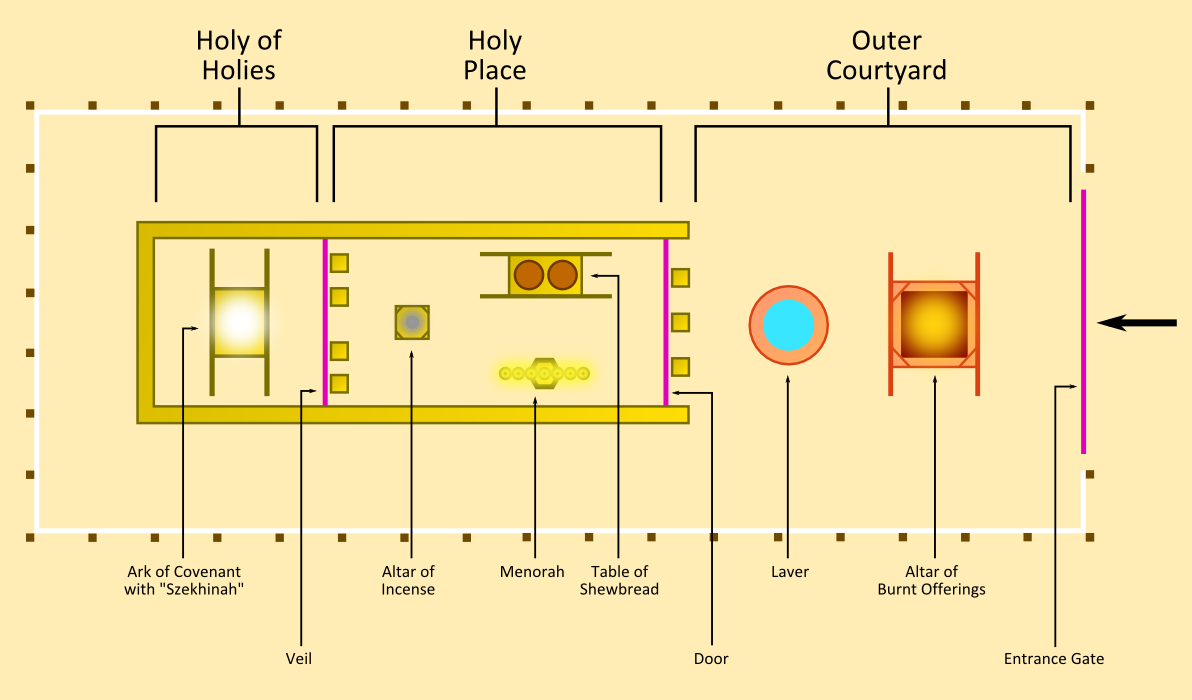
Solomon's temple was the same pattern, built in stone instead of cloth. A great bronze laver of water for washing called "the sea" (1 Kings 7:23–26). An altar in the courtyard. A holy place. A holy of holies separated by a veil. Priests washed at the laver before entering. Sacrifices were offered on the altar in similitude of the coming Lamb of God. Only the high priest, once a year on the Day of Atonement, passed through the veil into the holy of holies, the symbolic presence of God (Leviticus 16; Hebrews 9:7).
1 Kings 8:10–11
When the priests came out of the holy place at the dedication of Solomon's temple, "the cloud filled the house of the Lord, so that the priests could not stand to minister because of the cloud: for the glory of the Lord had filled the house of the Lord."
2 Chronicles 6:18
Solomon prayed at the dedication: "Will God in very deed dwell with men on the earth?" That is the question every temple answers: yes, He will, and here is the path.


Watch: ancient temples brought to life
What the New Testament says about the veil

"And, behold, the veil of the temple was rent in twain from the top to the bottom; and the earth did quake, and the rocks rent." Matthew 27:51, at the moment of the Savior's death.
The veil is Christ. When the Savior died, the veil tore from the top down, signaling that through His body and blood, all of us can come back into the presence of God. Every temple veil since carries that meaning.
"The temple is the house of the Lord. The basis for every temple ordinance and covenant, the heart of the plan of salvation, is the atonement of Jesus Christ. Every activity, every lesson, all we do in the Church, points to the Lord and His holy house." President Russell M. Nelson, "Personal Preparation for Temple Blessings," April 2001 General Conference.
08Personal Prep Checklist
Walk through your own readiness checklist.
Your personal prep checklist
Before the temple
The morning of
09Discussion
For the lesson conversation
- Pick one ritual from Section 1. What does the clothing, the words, or the action do for the person inside it?
- Why might God choose to use special clothing and symbolic actions instead of just talking to us?
- Read Exodus 40:12–13 together. What four things does the Lord ask Moses to do for Aaron? Where do you see those four things in the temple today?
- The endowment is called a gift. What gifts has God already given you that prepared you for this one?
- Look at the five endowment covenants and the baptismal covenant. Which one feels most natural to you right now? Which one will stretch you most?
- Why would the Lord tear the veil of the temple in two at the moment Christ died? What does that say about the meaning of every temple veil since?
- What questions do you still have? Who is the right person to take them to?
"Just focus on trying to feel the Spirit. Feel the binding strength of your covenants. Don't let any of the minutia get in the way. Notice how Jesus Christ is the central figure in the temple endowment." John Hilton III, Your First Temple Visit: A Practical Guide.
10Notes & Sources
Every doctrinal or practical claim in this lesson traces back to one of three tiers of source: (1) the standard works of the Church, (2) statements of living prophets and apostles published on churchofjesuschrist.org or in General Conference, and (3) the publicly available General Handbook. Where a faithful Latter-day Saint scholar (such as John Hilton III) is the source of a practical detail, that is noted by name. The lesson never repeats anything said inside the endowment ceremony that is intended to be kept inside the temple.
Primary Apostolic and Prophetic Sources
- President Russell M. Nelson, "Personal Preparation for Temple Blessings," April 2001 General Conference. Doctrinal anchor for the lesson. Covers the endowment as a gift, the requirement of worthiness, the garment, the five-fold purpose of temple ordinances, and the symbolic meaning of every part.
- President Russell M. Nelson, "The Temple and Your Spiritual Foundation," October 2021 General Conference. President Nelson invites every member to make the temple a centerpiece of their lives.
- President Brigham Young, definition of the endowment quoted in Teachings of Presidents of the Church: Brigham Young, chapter 32. Source of "your endowment is, to receive all those ordinances... necessary for you... to enable you to walk back to the presence of the Father." Brigham Young is also the most-cited public source naming "key words, signs and tokens, pertaining to the holy Priesthood" in conjunction with the temple endowment.
- Joseph Smith, Teachings of Presidents of the Church: Joseph Smith, chapter 31, "Temple Ordinances." The Prophet teaches the principles and order of the priesthood: washings, anointings, endowments, and the communication of keys. Foundational source for the existence of the temple ordinances and their priesthood ties.
- President Boyd K. Packer, "The Holy Temple," Ensign, February 1992. Apostolic treatment of the temple as a place of learning by symbol.
- Elder D. Todd Christofferson, "The Power of Covenants," April 2009 General Conference. On what it means to make and keep covenants with God.
Official Church Publications
- General Handbook, Section 27: Temple Ordinances and Covenants. The official publicly-available source for: the five covenants (27.2), the temple recommend process, the prayer roll, the wearing of the garment, the limited-use recommend for first endowment.
- Gospel Topics, "Temples." The Church's plain-language explanation of why temples exist and what happens there.
- Gospel Topics, "Temple Endowment." Explanation of the endowment, the five covenants, and references to apostolic teachings.
- Gospel Topics, "Temple Garments." Official Church teaching on the garment of the holy priesthood.
- "Sacred Temple Clothing," official Church video on the ceremonial robe, apron, sash, and head covering.
- churchofjesuschrist.org/temples. Official temple-preparation portal.
Bible Dictionary Entries (President Nelson's recommended list)
President Nelson, in his 2001 General Conference talk, recommended these seven entries as core preparation. All are on the official Church site:
Scriptures Cited (all from the King James Version on churchofjesuschrist.org)
- Tabernacle / consecration pattern: Exodus 28, 29, 40:12–13; Leviticus 8, 9:7, 16.
- Solomon’s temple: 1 Kings 7:23–26, 8:10–11; 2 Chronicles 6:18.
- Coats of skins: Genesis 3:21.
- Altar as similitude of Christ: Jacob 4:5.
- Veil torn at crucifixion: Matthew 27:51; Hebrews 10:19–20; Hebrews 9:7.
- Endowment / temple revelations: D&C 88:119–120; D&C 95:8; D&C 97:15–19; D&C 124:39–41 (the Lord enumerates the temple ordinances: washings, anointings, baptisms for the dead, solemn assemblies, memorials, oracles, statutes, and judgments).
- Baptismal covenant: Mosiah 18:8–10; D&C 20:37.
- Broken heart: 3 Nephi 9:20; 2 Nephi 2:7.
- One perfect sacrifice: Hebrews 10:12.
- New name examples: Genesis 17 (Abram→Abraham); Genesis 32 (Jacob→Israel); Acts 13 (Saul→Paul); Alma 23:17 (Anti-Nephi-Lehies).
- Endowment narration source: Moses 2:1 through Moses 5:11; Genesis 1–3.
- Two great commandments: Matthew 22:37–40.
- Sins as scarlet, white as snow: Isaiah 1:18.
Faithful Scholar Sources (cited where used)
- John Hilton III, BYU Professor of Religious Education, is the source for several of the practical step-by-step details in sections 3, 4, and 5. His three videos are linked in section 9 of this lesson. Dr. Hilton is also the author of Considering the Cross (Deseret Book, 2021) and other Church-published works.
- Encyclopedia of Mormonism (Macmillan, 1992; hosted at eom.byu.edu by Brigham Young University). Scholarly Latter-day Saint reference. See "Endowment" by Alma P. Burton for an overview of the endowment ordinance including the general place of signs and tokens, and "Prayer Circle" by George S. Tate for context on the prayer-circle formation.
Imagery and Multimedia
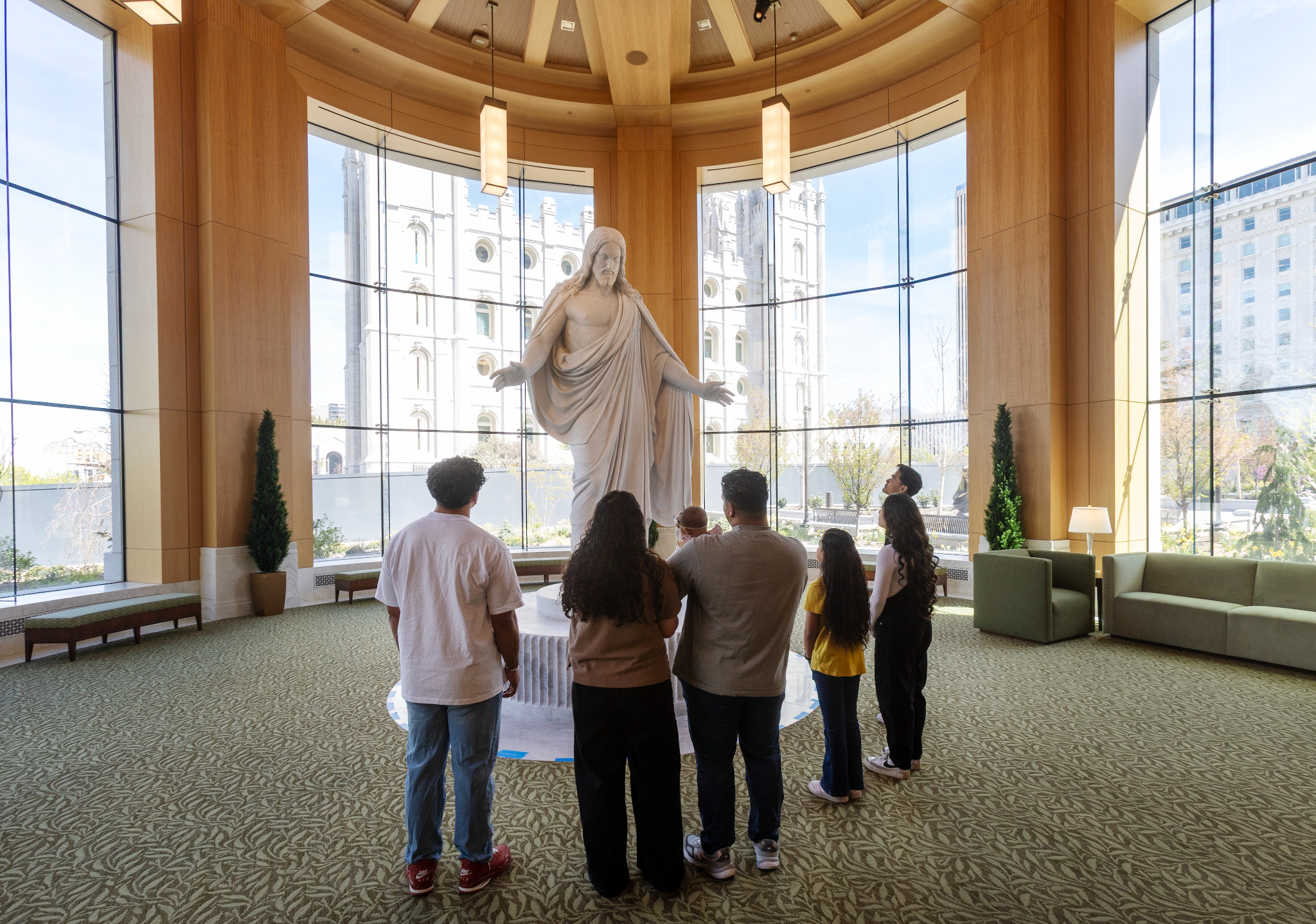
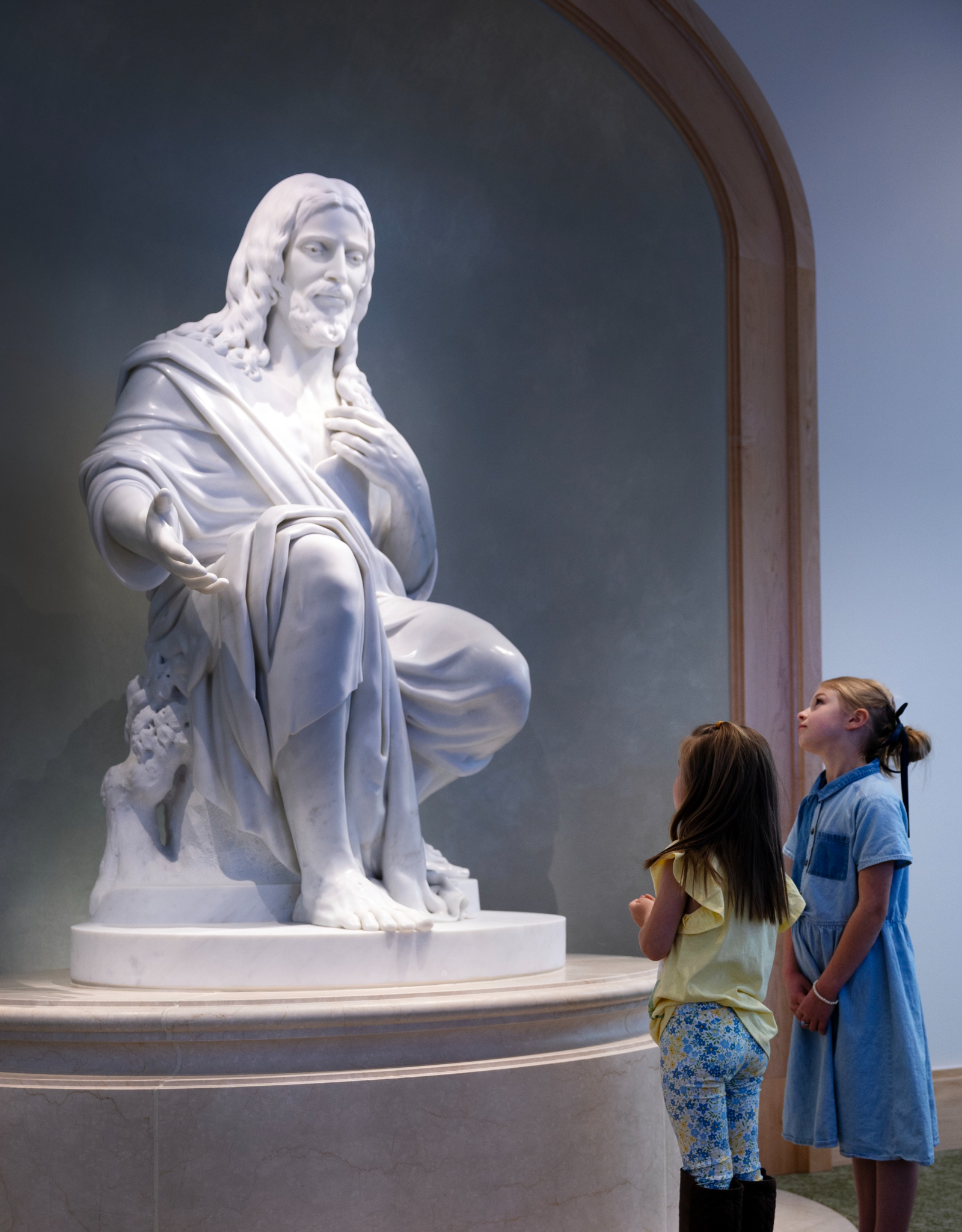
- Salt Lake Temple Visitor Center photos in this lesson are from the Church Newsroom press kit (photographer B. Nicholson), released for media use with attribution to The Church of Jesus Christ of Latter-day Saints, Newsroom.
- Tabernacle of Moses, Solomon’s Temple, and biblical artwork are from Wikimedia Commons, public domain or Creative Commons. Attribution is included in each figcaption.
- Ritual video clips in section 1 are embedded from their original YouTube uploaders and play under YouTube’s embed terms.
Footnote
- Prayer roll and circle. The mechanic of submitting names to the temple prayer roll is described in the publicly-available General Handbook section 27. John Hilton III gives a practical walk-through in Your First Temple Visit: A Practical Guide on YouTube (XBRMxYiwx_g). For a fuller scholarly treatment of the circle formation, see Encyclopedia of Mormonism, "Prayer Circle" by George S. Tate, a 1992 BYU reference work. This lesson keeps the description brief and does not describe what is said or done inside the circle. ↩ ↩
A note on this lesson
Compiled by Jason Wells for personal lesson use with youth preparing to enter the temple for the first time. Doctrine drawn only from publicly available, authorized Church sources. Where the lesson speaks of what happens inside the temple, it does so only at the level of detail the Church itself has chosen to publish. Anything not appropriate to share outside the temple is left for the youth to receive there, in the Lord’s own house.